A few months ago, I shared about the amazing UNESCO organization and its work in highlighting World Heritage Sites around the world. At that time, I wrote about some of the sites I’ve already visited. Today, I want to share a different list—places I hope to visit one day. Each of these locations came up in my Art History class this year, and learning about them sparked my curiosity even more. Now, I’d love the chance to experience them in person and see the architecture and history I’ve only studied in books.
The Great Pyramids of Giza, Egypt
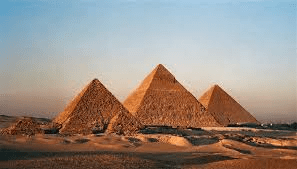
The Great Pyramids are well known throughout the world. Everyone would recognize a picture of this monument; they are also one of the Seven Wonders of the World! The monument is so popular that people have drawn up conspiracy theories about the pyramids including ideas that they were built by aliens! In reality, these pyramids were built throughout pharaoh’s life so that they would be ready for them when they died.
They were originally covered in bright reflective limestone, but now it is a skeleton of what it was. The shape was inspired by the Benben, the sacred mound in Egyptian mythology where the first god, Atum, was believed to have stood. From the Benben, Atum created the other gods. Because of this connection to creation and divine origins, rulers chose this shape for their monuments—symbolizing their return to the place where the gods themselves began as they entered the afterlife. The three pyramids are made for three pharoahs – Khufu, Khafre, and Menkaure. Khufu has the largest pyramid and Menkaure has the smallest. But the smallest pyramid is still about 205 feet fall; something I would love to visit!
Angkor Wat, Cambodia
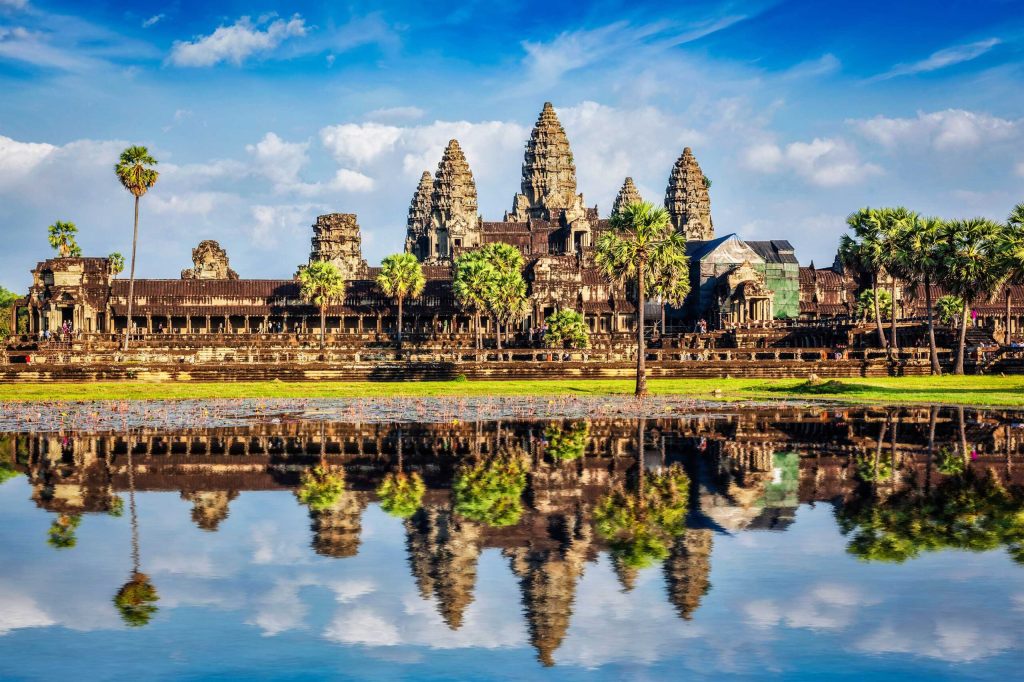
This Hindu temple was built Khmer King Suryavarman II. The temple was dedicated to Vishnu because a Hindu belief is that temples were the homes of gods. It served as the state temple and political center of the Khmer Empire. It later shifted to a Buddhist temple, but today serves as a tourist attraction.
It is one of the largest religious monuments in the world and a powerful symbol of Cambodia. Surrounded by water on all four sides, the complex creates a dramatic and majestic entrance for visitors. The temple is admired for the grandeur and harmony of the architecture, its extensive bas-reliefs, and for the numerous devatas adorning its walls. Devatas are often depicted as sculptures, that serve as divine protectors. They are common in Hindu and Buddhist temples. I would love to visit this complex. Before learning about it, I had never heard about Angkor Wat, but now that I have, I am fascinated by its intricate architectural details.
Rapa Nui National Park, Easter Island
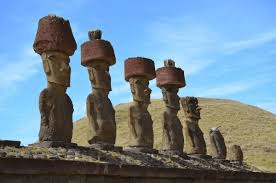
Rapa Nui, also known as Easter Island, is part of Chile and is famous for its mysterious stone statues called moai. These statues were created between the 10th and 16th centuries by the island’s Polynesian settlers and were placed on large stone platforms called ahu. Each moai represented an important ancestor, and building them was a way for the Rapa Nui people to honor their past and connect their community to the divine. The island also features petroglyphs, rock art, and the ceremonial village of Orongo.
Today, Rapa Nui National Park is a UNESCO World Heritage Site and a powerful symbol of Polynesian creativity and resilience. I would love to visit the island one day to see the moai in person. Learning about how these statues were carved, transported, and raised without outside influence has fascinated me. For a long time, scientists were not completely sure how these statues were moved because they are so large. To transport the moai from the quarry to the perimeter of the island, people would most likely tie ropes to the moai and rock them side to side to move them. This process must have taken a long time, but it is incredible that the Polynesian people were able to create and transport so many statues.

 Living in Culture
Leave a comment