Recently, I had the opportunity to see the Broadway show Suffs, written by Shaina Taub. This compelling musical dives into the Suffrage Movement, explaining the struggles and triumphs of the suffragists fighting for women’s right to vote. It was inspiring and moving, offering new insights into aspects of the movement that I hadn’t previously known. Centered around Alice Paul and her tireless efforts for gender equality, Suffs provides a powerful and educational look at this important chapter in history. Interestingly enough, my small suburban town has a connection to Alice Paul – she was born in Mount Laurel, NJ, passed away in a Quaker Facility in my hometown of Moorestown, and is buried one town over in Cinnaminson.
After leaving the theater, I reflected on the struggle for women’s rights in this country. Then I began to think about gender equality on a global scale, revealing significant disparities that persist worldwide. Inspired by these reflections, I want to write about women’s rights in various countries, pointing out where improvements are needed and shedding light on ongoing inequalities. Through this piece, I aim to inform and inspire action toward achieving gender equality everywhere.
Afghanistan
This country is seen by many to be the country with the worst gender inequality. With all of the conflict and crisis this country has faced for the past few decades, women and girls are left uneducated and helpless. Afghan women just gained the right to vote 20 years ago, after they lost that right in 1929. Especially with the Taliban regaining control, women’s rights are slipping away.
Decades of their hard-earned rights are being stripped away, even though the Taliban promised to uphold women and minority rights. Afghan women can no longer work and have minimal education. In July 2023, the last opportunity for women to have a job was taken when the Taliban demanded the closure of all beauty salons. Now, there are no opportunities for women to be self-sufficient, unless they work under the table to support their children. Girl’s education is also suffering. Following 2001, there was an increase in literacy rates, but in 2021 when the Taliban regained control women’s education was affected. Secondary and higher education is banned, leaving girls unable to get an education beyond sixth grade. Recently, they have been restricted from even speaking in public.
An article from worldhelp.net (linked here) describes what it is like to be a woman in Afghanistan. It follows a sixteen-year-old girl named Damsa, who is already the third wife to a much older man. It is an interesting and eye-opening read that I would recommend.
New Zealand
Some may think New Zealand is just a small country in the South Pacific, but it has a unique history as the first country to give women the right to vote in 1893, a complete one-eighty from Afghanistan. By the end of the 19th century, feminists in New Zealand had a long list of reforms needed in their country, including equal pay, reforms in marriage and divorce, better health and education, and economic independence.
The women’s suffrage movement gained widespread support, led by Kate Sheppard, Christina Henderson, and the Women’s Christian Temperance Union created in 1885, based on the American organization founded in 1873. They also gained the support of influential male politicians like Sir Robert Stout, John Hall, and William Fox. The two main factors influencing New Zealand’s global first for women included a small population and a lack of conservative traditions.
Fast forward to 2017, a 37-year-old prime minister was elected, named Jacinda Ardern, who at the time was the world’s youngest female head of state. Women’s roles in government are continuing to advance, today there are more women of color, LGBTQ+ and indigenous members of Parliament than ever before, showing progress for equality for all.
To finish this piece, I wanted to touch on Suffrage Movement in the United States. I think there are many details that are unknown to a multitude of people, and that are important to be shared. Women began organizing for suffrage in the 1840s, with the First Women’s Rights Convention being held in 1848. However, it wasn’t until 1920 when women were given the right to vote. What happened in those 80 years?
The United States
Leaders like Susan B. Anthony and Alice Paul were instrumental in obtaining women’s voting rights. Susan B. Anthony was involved in founding the Women’s Loyal National League, and Alice Paul helped to organize the first women’s suffragist parade in Washington D.C. Anthony died fourteen years before the 19th Amendment was ratified, but she traveled all around the country giving speeches and organizing suffragists to protest for voting rights.
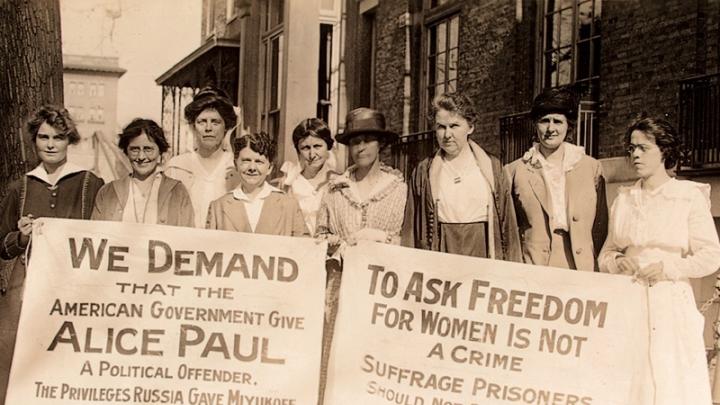
Through the musical “Suffs,” I learned so much about the life of Alice Paul. Her mother was a supporter of the Suffrage Movement, so that is where her interest originally started. She was a persistent leader, never taking no for an answer. Paul created the National Woman’s Party alongside Lucy Burns that met with President Wilson numerous times until they had his support.
Alice Paul gave up so much for this movement, deciding not to marry to be able to spend all of her time organizing protests. She, like many other suffragists, were imprisoned for their protesting. Paul was placed in jail three times, and was force fed when she attempted hunger strikes, placed in solidarity confinement, and threatened to be placed in an insane asylum. Many women went through similar hardships, but regardless, they persisted, never losing hope.
In conclusion, women’s rights look different around the world, something that is easy to forget. Some countries are further than others, but there are still major strides that can be taken in gender equality. This Human Rights Careers article (linked here) details 25 organizations dedicated to gender equality if you are interested in learning more.

 Living in Culture
Leave a comment